
Article: What Is Mother of Pearl? A Collector’s Guide to Shell Inlay and Lacquerware

What Is Mother of Pearl? A Collector’s Guide to Shell Inlay and Lacquerware
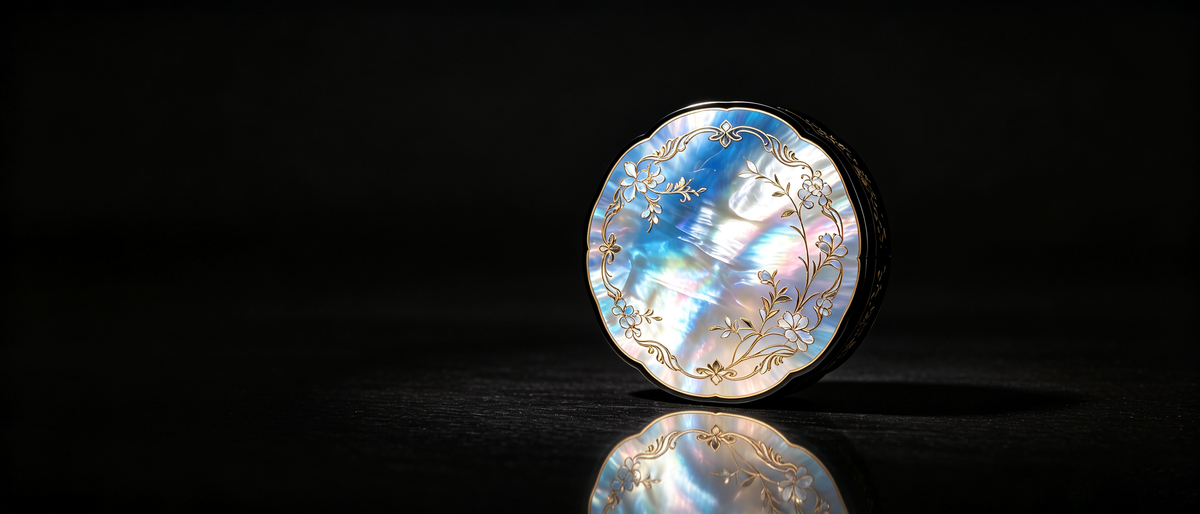
Mother of pearl is one of those materials that is difficult to understand from a photograph alone. Its surface seems quiet at first, then changes as the angle of light shifts. Blues, greens, rose, silver and violet can appear and disappear across the same fragment of shell. That movement is not a printed effect or surface coating. It comes from the structure of nacre itself.
For collectors, this is the beginning of its appeal. Mother of pearl is not simply decorative. It is a natural material whose color, reflectivity and depth are revealed gradually, and whose beauty depends on how carefully it is selected, cut, set and finished.
What is mother of pearl?
Mother of pearl, also called nacre, is the iridescent material that forms on the inner surface of certain mollusk shells. It is made from microscopic mineral platelets arranged in thin layers. Light enters those layers, reflects at slightly different depths, and produces the shifting colors associated with nacre.
This is why two pieces of shell can look completely different even when they come from the same species. One may appear pale and silvery; another may carry stronger blue, green or pink tones. Natural variation is part of the material, not a defect.
Why does mother of pearl seem to change color?
The color of nacre is structural rather than simply pigmented. As light moves across the surface, the reflected wavelengths change. A detail that looks grey from one direction may turn blue-green from another, then almost disappear into white light.
This optical behavior is especially important in lacquerware. Against a deep lacquer ground, the shell can appear to float above the surface in one moment and recede into it in the next. The effect depends on contrast, polish, shell thickness, placement and the angle at which the object is viewed.
What is shell inlay?
Shell inlay is the process of cutting thin pieces of nacre and setting them into or onto a prepared surface. In refined work, the shell is not used as a single sheet. Individual fragments are selected, cut and arranged to create lines, motifs, fields of color or highly detailed compositions.
The maker must account for the direction of the nacre. Rotating a fragment only slightly can alter the way it reflects light. Good inlay therefore requires more than accurate cutting. It requires judgment: which part of the shell to use, how thick it should be, how pieces should meet, and how the final surface will behave under changing light.
Mother of pearl and lacquerware
Lacquer creates an ideal setting for nacre because the two materials respond to light in very different ways. A lacquered surface can be deep, controlled and visually quiet. Mother of pearl is luminous and changeable. When the two are balanced well, the shell does not simply sit on top of the object; it becomes part of the depth of the surface.
Traditional lacquer techniques are built slowly through repeated stages of coating, curing, leveling and polishing. In shell-inlaid work, this process becomes even more demanding because the inlay must be integrated without losing the crispness of its edges or the natural brilliance of the shell.
The final impression should not be rough or overloaded. Even highly detailed work can feel calm when proportion, spacing and polishing are controlled.
What does “raden” mean?
Raden is a Japanese term widely used for lacquerware decorated with shell inlay, especially mother of pearl. Related shell-inlay traditions also developed across East Asia over long periods, including sophisticated Chinese and Korean practices. The terminology varies by region and period, but the underlying craft principle is similar: thin nacre is cut, arranged and incorporated into a lacquered or otherwise prepared surface.
For modern collectors, it is useful to look beyond the label alone. The quality of an object is better understood through material, workmanship, condition, design and finishing than through a single term.
How can you judge the quality of mother-of-pearl inlay?
Several details are worth examining closely.
1. The shell itself. Look for natural variation and depth rather than a flat, printed-looking sheen. Fine nacre should respond differently as the object moves under light.
2. Edge precision. Cleanly cut pieces and controlled junctions usually indicate careful handwork. Ragged edges or careless gaps weaken the visual effect.
3. Surface integration. The inlay should feel visually integrated with the lacquer rather than crudely attached. The surface may not be perfectly uniform on a handmade object, but it should feel intentional.
4. Composition. More inlay is not automatically better. Restraint, proportion and rhythm matter. A small amount of well-placed shell can be more powerful than an overcrowded surface.
5. Finish. Polishing determines how clearly both lacquer and nacre are seen. A refined finish should reveal depth without making the object look artificially glossy.
Are variations and irregularities normal?
Yes. Mother of pearl is a natural material, and traditional craft processes are performed by hand. Small variations in shell color, grain, placement and surface character are expected. They are often what distinguish a handmade object from a mechanically reproduced one.
What matters is the difference between natural variation and careless workmanship. Variation should contribute to the character of the object; poor construction, unstable inlay or damaged surfaces are different issues.
How should mother-of-pearl lacquerware be cared for?
Keep lacquerware away from prolonged direct sunlight, strong heat and extremely dry conditions. Clean it gently with a soft, dry or slightly damp cloth, and avoid abrasive cleaners or aggressive polishing compounds. Sharp jewelry or hard objects can scratch a lacquered surface, so storage pieces should be used with care.
For collectible objects, stable conditions matter more than frequent cleaning. The goal is preservation rather than making the surface look newly polished at all times.
Why do collectors value mother-of-pearl objects?
Part of the value lies in rarity and workmanship, but the deeper attraction is experiential. A well-made shell-inlaid object does not reveal everything immediately. Its appearance changes with distance, light and movement. Details emerge slowly.
That quality gives mother of pearl a particular presence. It can be decorative without being loud, intricate without losing restraint, and luxurious without depending on obvious symbols of luxury.
For NACREVERSE, this is the point of presenting these works as collectible objects rather than disposable decoration. The material carries its own history, the making requires time, and the finished piece deserves the same attention with which it was created.
A material best understood in person
Mother of pearl is often described through words such as iridescent, luminous or pearlescent, but none fully captures what happens when the object is moved in real light. Its character lies in that change.
For anyone beginning to explore shell-inlaid lacquerware, the most useful habit is simple: look slowly. Observe the edges, the polish, the density of the inlay and the way the shell reacts as the viewing angle changes. The finest pieces do not need to announce their complexity. They reveal it over time.